


Manufacturer support for the HPE 3PAR StoreServ 8000 series expired on 31 August 2026. That date marks the EOSL. Anyone still running these arrays has been working since then without firmware patches, without fixes for security vulnerabilities and without certification of new host operating systems. Spare parts now come only from the secondary market or through a maintenance contract with a third party provider.
For storage systems, HPE works with two stages in the product lifecycle. With end of life (EOL), a model disappears from distribution; it can only be ordered from remaining stock. Roughly five years later comes end of service life (EOSL), from which point HPE Pointnext provides no services whatsoever. For the 8000 series, HPE announced the end of sales in February 2021, distribution ran out on 31 August 2021, and five years later support ended. The date was also confirmed in the HPE Community.
The following overview lists all base and upgrade SKUs for the four models 8200, 8400, 8440 and 8450. We maintain these systems until 31 August 2036, ten years beyond the official EOSL. For the upgrade node pairs, which are listed as expansion components, our general rule of seven to ten years after EOL applies. The data comes from our HPE end of life list and the overview of 3PAR maintenance.
Full overview: all models in the 3PAR StoreServ 8000 series
| Model | Model number | EOL | EOSL | Extended support by Hardwarewartung.com |
| HPE 3PAR StoreServ 8200 2-node+software storage base | K2Q35B | Aug 31, 2021 | Aug 31, 2026 | Aug 31, 2036 |
| HPE 3PAR 8200 2-node+software storage centric base | K2Q37B | Aug 31, 2021 | Aug 31, 2026 | Aug 31, 2036 |
| HPE 3PAR 8200 2-node+software storage field base | K2Q36B | Aug 31, 2021 | Aug 31, 2026 | Aug 31, 2036 |
| HPE 3PAR 8400 2-node storage base with all-inclusive single-system software | H6Y95B | Aug 31, 2021 | Aug 31, 2026 | Aug 31, 2036 |
| HPE 3PAR 8400 4-node storage base with all-inclusive single-system software | H6Z01B | Aug 31, 2021 | Aug 31, 2026 | Aug 31, 2036 |
| HPE 3PAR 8400 2-node+software storage centric base | H6Z12B | Aug 31, 2021 | Aug 31, 2026 | Aug 31, 2036 |
| HPE 3PAR 8400 4-node storage base with all-inclusive single-system software for storage centric rack | H6Z03B | Aug 31, 2021 | Aug 31, 2026 | Aug 31, 2036 |
| HPE 3PAR 8400 2-node+software storage field base | H6Y96B | Aug 31, 2021 | Aug 31, 2026 | Aug 31, 2036 |
| HPE 3PAR 8400 4-node+software storage field base | H6Z02B | Aug 31, 2021 | Aug 31, 2026 | Aug 31, 2036 |
| HPE 3PAR 8400 Upgrade node pair with all-inclusive single-system software | H6Z06B | Aug 31, 2021 | Aug 31, 2026 | 7 to 10 years after EOL |
| HPE 3PAR StoreServ 8440 2-node+software storage base | H6Y97B | Aug 31, 2021 | Aug 31, 2026 | Aug 31, 2036 |
| HPE 3PAR StoreServ 8440 4-node+software storage base | H6Y98B | Aug 31, 2021 | Aug 31, 2026 | Aug 31, 2036 |
| HPE 3PAR 8440 2-node storage base with all-inclusive single-system software for storage centric rack | H6Z09B | Aug 31, 2021 | Aug 31, 2026 | Aug 31, 2036 |
| HPE 3PAR 8440 4-node+software storage centric base | H6Z14B | Aug 31, 2021 | Aug 31, 2026 | Aug 31, 2036 |
| HPE 3PAR 8440 2-node+software storage field base | H6Z07B | Aug 31, 2021 | Aug 31, 2026 | Aug 31, 2036 |
| HPE 3PAR 8440 4-node+software storage field base | H6Z13B | Aug 31, 2021 | Aug 31, 2026 | Aug 31, 2036 |
| HPE 3PAR 8440 Upgrade node pair with all-inclusive single-system software | H6Z08B | Aug 31, 2021 | Aug 31, 2026 | 7 to 10 years after EOL |
| HPE 3PAR 8450 2-node storage base with all-inclusive single-system software | H6Z17B | Aug 31, 2021 | Aug 31, 2026 | Aug 31, 2036 |
| HPE 3PAR 8450 4-node storage base with all-inclusive single-system software | H6Z23B | Aug 31, 2021 | Aug 31, 2026 | Aug 31, 2036 |
| HPE 3PAR 8450 2-node storage base with all-inclusive single-system software for storage centric rack | H6Z20B | Aug 31, 2021 | Aug 31, 2026 | Aug 31, 2036 |
| HPE 3PAR 8450 4-node storage base with all-inclusive single-system software for storage centric rack | H6Z25B | Aug 31, 2021 | Aug 31, 2026 | Aug 31, 2036 |
| HPE 3PAR 8450 2-node storage field integrated base with all-inclusive single-system software | H6Z18B | Aug 31, 2021 | Aug 31, 2026 | Aug 31, 2036 |
| HPE 3PAR 8450 4-node storage field integrated base with all-inclusive single-system software | H6Z24B | Aug 31, 2021 | Aug 31, 2026 | Aug 31, 2036 |
| HPE 3PAR StoreServ 8450 4-node field integrated storage base | H6Z24A | Aug 31, 2021 | Aug 31, 2026 | Aug 31, 2036 |
| HPE 3PAR 8450 Upgrade node pair with all-inclusive single-system software | H6Z19B | Aug 31, 2021 | Aug 31, 2026 | 7 to 10 years after EOL |
Table: EOL and EOSL for all models in the 3PAR StoreServ 8000 series
Professional HPE Maintenance from the Specialists
Get your HPE Care Pack for your end of life hardware. We maintain your EOL hardware for up to 10 years past its expiry date, and on the best terms. Simply ask us for a quote, quickly and without any fuss.
Technical characteristics of the HPE 3PAR StoreServ 8000 series
The 8000 series came to market in August 2015 as the successor to the StoreServ 7000. All four models share the same basic architecture but differ in CPU configuration, cache size and maximum expansion. The controllers work in a mesh-active cluster: every node accesses the same logical storage pool simultaneously, and a node failure costs capacity while availability is maintained. The details are in the QuickSpecs for the 3PAR StoreServ 8000.
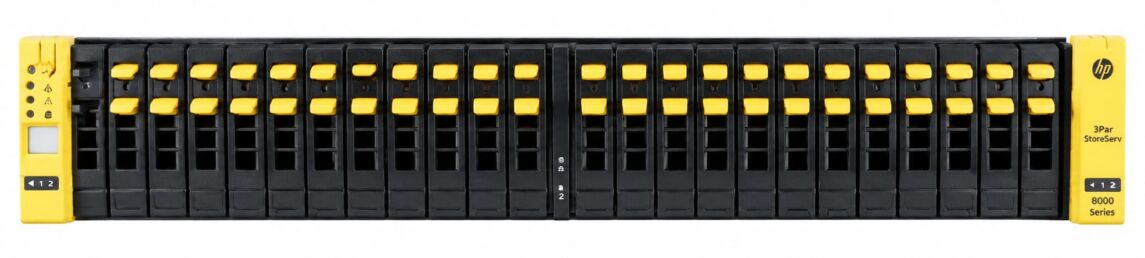
What set these arrays apart from comparable systems of the time was the Gen5 Thin Express ASIC. This component handles inline deduplication and zero-detect in hardware, keeping the main CPUs free for other tasks. Empty blocks automatically return to the free pool, which saves noticeable space in VMware and Hyper-V environments. A controller node pair occupies two rack units and takes 24 SFF SAS drives. See also HPE’s system specifications.
On the software side, HPE shipped the arrays with the All-Inclusive Single-System Software, which replaced the earlier per-spindle licensing. Included were Virtual Copy for snapshots, Adaptive Optimization for automatic tiering at chunklet level, Dynamic Optimization for changes to RAID level and drive type during live operation, and Priority Optimization for IOPS and latency limits per application. File Persona brought SMB and NFS directly to the block controllers.
The last operating system version for this hardware is 3PAR OS 3.3.2. It introduced cross-generation replication over Fibre Channel, which allowed data to be mirrored directly to HPE Primera, as the release information for 3.3.2 describes. Later patches such as 3.3.2 MU1 Patch 08 added firmware for newer SSD models.
Anyone still replacing drives today should check the OS level: older versions do not recognise newer SKUs, and in the worst case an OS upgrade after a drive failure can only be carried out offline.
HPE 3PAR StoreServ 8200
The 8200 was the entry point into the series and replaced the widely used StoreServ 7200. It is permanently designed for two controller nodes; the architecture does not allow expansion to four nodes. It is driven by two 6-core processors at 2.2 GHz and two Gen5 ASICs.
The cache comprises 64 GiB of on-node DRAM, plus an optional 768 GiB of flash cache for Adaptive Optimization. Up to twelve host ports allow Fibre Channel, 10Gb iSCSI, FCoE or Ethernet connections. Nine additional drive enclosures bring the system to a maximum of 240 hard disks or 120 SSDs, which works out at around 1,000 TiB of raw capacity. For consolidation projects in mid-sized companies, that was sufficient for years.
All three base SKUs share the same lifecycle dates. The difference lies in the delivery form: “storage base” denotes the standard system, “storage centric base” the variant for the HPE Storage Centric Rack, and “field base” the version integrated on site. Which SKU is in your rack is shown in the model overview at HPE.
| Model | Model number | EOL | EOSL | Extended support by Hardwarewartung.com |
| HPE 3PAR StoreServ 8200 2-node+software storage base | K2Q35B | Aug 31, 2021 | Aug 31, 2026 | Aug 31, 2036 |
| HPE 3PAR 8200 2-node+software storage centric base | K2Q37B | Aug 31, 2021 | Aug 31, 2026 | Aug 31, 2036 |
| HPE 3PAR 8200 2-node+software storage field base | K2Q36B | Aug 31, 2021 | Aug 31, 2026 | Aug 31, 2036 |
Table: HPE 3PAR StoreServ 8200 EOL and EOSL
Professional HPE Maintenance from the Specialists
Get your HPE Care Pack for your end of life hardware. We maintain your EOL hardware for up to 10 years past its expiry date, and on the best terms. Simply ask us for a quote, quickly and without any fuss.
HPE 3PAR StoreServ 8400
The 8400 was the workhorse of the series. It starts with two nodes and can be expanded to four during live operation, for which the upgrade node pair is available under SKU H6Z06B. Fully populated, four 6-core CPUs at 2.2 GHz and four Gen5 ASICs work in the system.
The cache doubles compared with the 8200 to 128 GiB of on-node RAM plus up to 1,536 GiB of flash cache. The 8400 drives up to 24 host ports and manages 4,096 initiators. On the back end, up to 22 drive enclosures hold a maximum of 576 hard disks or 240 SSDs, around 2,400 TiB in total. With the drives, it is worth checking the OS level: support for 14 TB NL-SAS disks came late and is tied to a minimum version, as a discussion in the HPE Community shows.
In our list, the upgrade node pair does not fall under the fixed date of 31 August 2036, because it is treated as an expansion component rather than a standalone system. For components of this kind, the rule of seven to ten years after EOL applies, and we clarify the specific term on a case-by-case basis.
| Model | Model number | EOL | EOSL | Extended support by Hardwarewartung.com |
| HPE 3PAR 8400 2-node storage base with all-inclusive single-system software | H6Y95B | Aug 31, 2021 | Aug 31, 2026 | Aug 31, 2036 |
| HPE 3PAR 8400 4-node storage base with all-inclusive single-system software | H6Z01B | Aug 31, 2021 | Aug 31, 2026 | Aug 31, 2036 |
| HPE 3PAR 8400 2-node+software storage centric base | H6Z12B | Aug 31, 2021 | Aug 31, 2026 | Aug 31, 2036 |
| HPE 3PAR 8400 4-node storage base with all-inclusive single-system software for storage centric rack | H6Z03B | Aug 31, 2021 | Aug 31, 2026 | Aug 31, 2036 |
| HPE 3PAR 8400 2-node+software storage field base | H6Y96B | Aug 31, 2021 | Aug 31, 2026 | Aug 31, 2036 |
| HPE 3PAR 8400 4-node+software storage field base | H6Z02B | Aug 31, 2021 | Aug 31, 2026 | Aug 31, 2036 |
| HPE 3PAR 8400 Upgrade node pair with all-inclusive single-system software | H6Z06B | Aug 31, 2021 | Aug 31, 2026 | 7 to 10 years after EOL |
Table: HPE 3PAR StoreServ 8400 EOL and EOSL
Professional HPE Maintenance from the Specialists
Get your HPE Care Pack for your end of life hardware. We maintain your EOL hardware for up to 10 years past its expiry date, and on the best terms. Simply ask us for a quote, quickly and without any fuss.
HPE 3PAR StoreServ 8440
The 8440 is the most powerful hybrid model in the series. Externally it matches the 8400; inside sit 10-core processors at 2.4 GHz instead of the 6-core CPUs.
The biggest leap is in the cache: 384 GiB of on-node DRAM and up to 8,000 GiB of flash cache, around 8,384 GiB together. This keeps metadata and hot blocks permanently in fast memory, which benefits OLTP databases and dense virtualisation clusters. Across 38 drive enclosures, the system scales to 960 hard disks or 480 SSDs and therefore to up to 4,000 TiB of raw capacity.
Systems of this size rarely stand alone. Anyone with an 8440 in their inventory usually also runs replication partners, service processors and several expansion enclosures. When drawing up a contract after EOSL, it therefore matters that coverage extends beyond the controllers to the enclosures, the service processor and the drives.
| Model | Model number | EOL | EOSL | Extended support by Hardwarewartung.com |
| HPE 3PAR StoreServ 8440 2-node+software storage base | H6Y97B | Aug 31, 2021 | Aug 31, 2026 | Aug 31, 2036 |
| HPE 3PAR StoreServ 8440 4-node+software storage base | H6Y98B | Aug 31, 2021 | Aug 31, 2026 | Aug 31, 2036 |
| HPE 3PAR 8440 2-node storage base with all-inclusive single-system software for storage centric rack | H6Z09B | Aug 31, 2021 | Aug 31, 2026 | Aug 31, 2036 |
| HPE 3PAR 8440 4-node+software storage centric base | H6Z14B | Aug 31, 2021 | Aug 31, 2026 | Aug 31, 2036 |
| HPE 3PAR 8440 2-node+software storage field base | H6Z07B | Aug 31, 2021 | Aug 31, 2026 | Aug 31, 2036 |
| HPE 3PAR 8440 4-node+software storage field base | H6Z13B | Aug 31, 2021 | Aug 31, 2026 | Aug 31, 2036 |
| HPE 3PAR 8440 Upgrade node pair with all-inclusive single-system software | H6Z08B | Aug 31, 2021 | Aug 31, 2026 | 7 to 10 years after EOL |
Table: HPE 3PAR StoreServ 8440 EOL and EOSL
Professional HPE Maintenance from the Specialists
Get your HPE Care Pack for your end of life hardware. We maintain your EOL hardware for up to 10 years past its expiry date, and on the best terms. Simply ask us for a quote, quickly and without any fuss.
HPE 3PAR StoreServ 8450
The 8450 is the pure all-flash array of the series. On this model, HPE dropped support for rotating hard disks entirely; it takes SSDs only.
It shares CPUs and ASICs with the 8440: four Gen5 ASICs and 10-core processors at 2.4 GHz. The architecture does without the secondary flash cache, because SSDs deliver low latencies by nature. What remains is 384 GiB of on-node RAM. Up to 480 SSDs with capacities from 1.92 TB to 15.36 TB can be attached. The target audience was transactional databases and latency-critical cloud environments.
On the 8450, the number of base SKUs is higher than on the other models, because here HPE also listed the older A variant H6Z24A alongside the B variants. The same lifecycle dates apply to all of them.
| Modell | Modellnummer | EOL | EOSL | Extended Support bei Hardwarewartung.com |
| HPE 3PAR 8450 2-node storage base with all-inclusive single-system software | H6Z17B | Aug 31, 2021 | Aug 31, 2026 | Aug 31, 2036 |
| HPE 3PAR 8450 4-node storage base with all-inclusive single-system software | H6Z23B | Aug 31, 2021 | Aug 31, 2026 | Aug 31, 2036 |
| HPE 3PAR 8450 2-node storage base with all-inclusive single-system software for storage centric rack | H6Z20B | Aug 31, 2021 | Aug 31, 2026 | Aug 31, 2036 |
| HPE 3PAR 8450 4-node storage base with all-inclusive single-system software for storage centric rack | H6Z25B | Aug 31, 2021 | Aug 31, 2026 | Aug 31, 2036 |
| HPE 3PAR 8450 2-node storage field integrated base with all-inclusive single-system software | H6Z18B | Aug 31, 2021 | Aug 31, 2026 | Aug 31, 2036 |
| HPE 3PAR 8450 4-node storage field integrated base with all-inclusive single-system software | H6Z24B | Aug 31, 2021 | Aug 31, 2026 | Aug 31, 2036 |
| HPE 3PAR StoreServ 8450 4-node field integrated storage base | H6Z24A | Aug 31, 2021 | Aug 31, 2026 | Aug 31, 2036 |
| HPE 3PAR 8450 Upgrade node pair with all-inclusive single-system software | H6Z19B | Aug 31, 2021 | Aug 31, 2026 | 7 to 10 years after EOL |
Table: HPE 3PAR StoreServ 8450 EOL and EOSL
Professional HPE Maintenance from the Specialists
Get your HPE Care Pack for your end of life hardware. We maintain your EOL hardware for up to 10 years past its expiry date, and on the best terms. Simply ask us for a quote, quickly and without any fuss.
Drives and components reach their end before the array does
An array reaches EOSL as a whole; its components follow schedules of their own. HPE announced the end of sales for individual Fast Class and Nearline SAS drives, among them the SKUs M0S92B, M0S93B and K2P99B, as early as 31 December 2020, as documented in the corresponding customer notice. For older HDDs in the STHB series, HPE restricted availability as original spare parts from March 2019 onwards and pointed to alternative parts.
For the warranty scope of drives bought later, the purchase date applies, not the array date. SSDs from orders placed before October 2017 had a five-year warranty; purchases from 2019 and 2020 only two. In installations that have grown over time, individual components therefore drop out of manufacturer coverage years before the rest of the system.
A further point concerns the service processors. HPE switched off the Secure Service Agent transport protocol for versions up to 5.0.6 on 1 January 2021. Anyone who has not moved to RDA or updated the service processor to 5.0.7 no longer has call-home data transmitted, the local log partitions fill up and OS packages can no longer be downloaded. The details are in the HPE advisory on the service processor.
Migration paths when continued operation is not an option
If compliance requirements call for active manufacturer support, there is no way around a changeover. HPE directs customers of the 8000 series to Primera, Nimble Storage and Alletra. To avoid rebuilding an entire rack, there are data-in-place upgrades and HPE Peer Motion, which moves virtual volumes, hosts and consistency groups to the target system during live operation.
The prerequisites are strict. The target system needs the same or a newer OS version, and the source system must not be newer. The Fibre Channel fabric has to support NPIV, because Peer Motion creates virtual ports that take on the identity of the old array. In mixed host landscapes of Windows, VMware, Linux and AIX, the ALUA host personas have to be configured identically on both sides, otherwise the multipathing drivers will not notice the path change. HPE lists the full set of limitations in the Peer Motion documentation.
What the dates mean for your planning
31 August 2026 is already behind us. For every 3PAR 8000 still running in production today, the question is therefore about the existing installation: how critical is the system, how quickly does it have to be running again after a failure, and where do the spare parts come from.
Technically, these arrays are not finished. Up to 4,000 TiB of raw capacity and flash caches in the terabyte range can carry secondary workloads, backup targets and disaster recovery sites for years to come. What is missing is spare parts and a binding response time.
That is exactly what our maintenance contracts cover. We buy up European spare parts stock and work independently of the HPE supply chain as a result. Covered are storage controllers, Fibre Channel adapters, SFP transceivers, I/O modules, power supplies and every drive type from FC through NL-SAS to SSD. Cache batteries count as consumables and are sourced separately. In the Critical Care package, the technician’s arrival time is four hours, and the call-to-repair option guarantees repair within four, six or eight hours. Compared with a post-warranty CarePack, customers generally save around half. You will find the details under storage maintenance and HPE maintenance.
In practice, a split strategy works well: tier 1 production data moves to a current platform via Peer Motion, while the rest of the installation carries on under third party maintenance and serves as an inexpensive second tier. This creates time for the migration without a failure turning into a risk.
Professional HPE Maintenance from the Specialists
Get your HPE Care Pack for your end of life hardware. We maintain your EOL hardware for up to 10 years past its expiry date, and on the best terms. Simply ask us for a quote, quickly and without any fuss.
Here is the most recently updated end of life hardware list for HP. As always, we offer our maintenance for at least 7 years beyond the end of life date. In reality, we can often provide maintenance well beyond those 7 years. If you need an HP maintenance contract for end of life hardware or for current hardware, simply contact us via our contact form.