



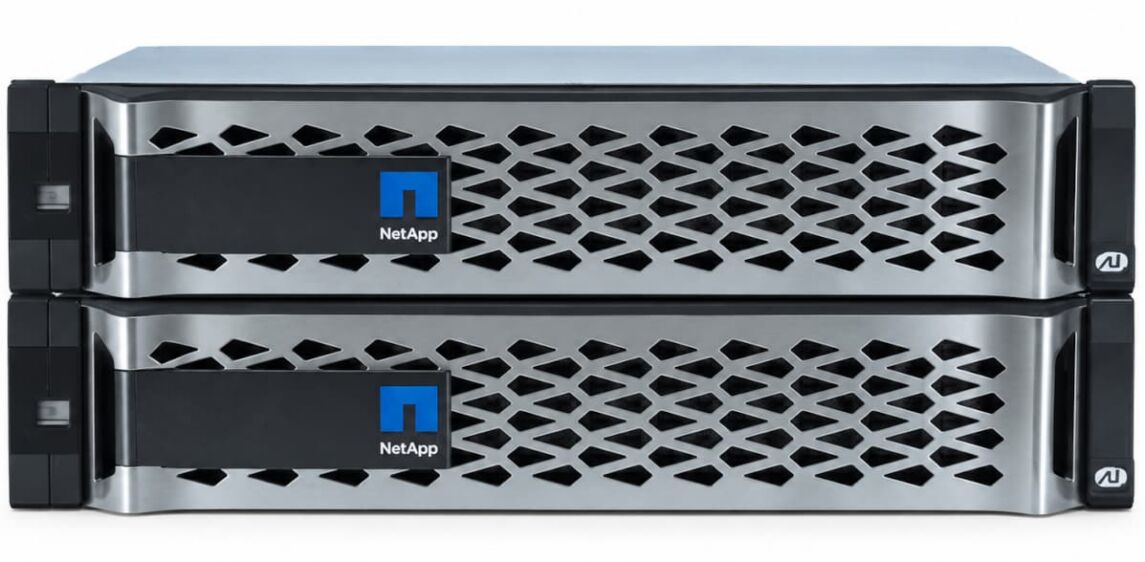
NetApp AFF A220: EOL, EOSL and Your Options Afterwards
Manufacturer support for the NetApp AFF A220 ends on 30 November 2026. From 1 December onwards, NetApp will no longer accept support cases for this platform, will not supply spare parts and will not release any further firmware for it. The systems keep running exactly as before. From that point on, the risk of any failure sits with the operator. This page shows what falls away on the EOSL date, how the A220 is set up technically and which three paths remain open afterwards.
Key facts at a glance
- The NetApp AFF A220 has been available since May 2018 as the entry-level system in the AFF series for mid-sized companies and edge locations.
- The system is no longer sold by the manufacturer.
- EOSL / end of support is 30 November 2026.
- Spare parts are likely to remain available on the secondary market for considerably longer.
What do EOL and EOSL mean for the NetApp AFF A220?
EOL, or end of availability, meaning the end of sales for the AFF A220, was in October 2021. After EOL, support initially continues without restriction. Operators still receive spare parts, firmware updates and technical support through their active maintenance contracts.
Once EOSL is reached on 30 November 2026, the manufacturer terminates all contractual service and support obligations.
We Maintain Your NetApp AFF A220 at the Best Price
Decades of experience have taught us what matters when maintaining your NetApp AFF A220. Benefit not only from our experience, but also from our excellent prices. Get a no-obligation quote and compare for yourself.
What changes on 30 November 2026
- Access to the NetApp Technical Assistance Center for troubleshooting, core dumps and performance analysis for the AFF A220 ends.
- RMA and SLA: there will no longer be any guaranteed parts replacement by the manufacturer.
- NetApp no longer evaluates AutoSupport data and no longer raises any tickets from it.
Maintenance, support and spare parts procurement then have to be covered by a third party maintenance partner if you want to keep running your hardware.
Technical specifications of the NetApp AFF A220
| Characteristic | AFF A220 (HA Pair) |
| Form Factor | 2 height units, chassis identical in construction with FAS2750 |
| CPUs | 2x Intel Xeon D-1557, 12 cores each, 1,50 GHz |
| Memory | 64 GB, 32 GB for each controller, additional 8 GB NVRAM for writing cache |
| Host Ports | 8x UTA2, optional 16 Gb FC or 10 GbE, alternatively 8x 10GBASE-T |
| Backend | 8x 12 Gb/s Mini-SAS HD for DS224C-Shelves |
| Expansion Slots | None, die ports equipment defined with shipment |
| Drives | 24 internal, up to 144 in full expansion, about 4,4 PB gross |
| Performance | up to 375.000 IOPS, about 6,2 GB/s sequential reading, latency about 1 ms |
Table: Technical specifications of the NetApp AFF A220
Without PCIe slots, the network connectivity cannot be upgraded. On the back end, the A220 works with SAS, whereas its successor, the AFF A250, uses NVMe throughout and delivers around 45 percent more IOPS in the same form factor.
We Maintain Your NetApp AFF A220 at the Best Price
Decades of experience have taught us what matters when maintaining your NetApp AFF A220. Benefit not only from our experience, but also from our excellent prices. Get a no-obligation quote and compare for yourself.
Last supported ONTAP version for the AFF A220
Some EOSL overviews state that ONTAP 9.16.1 is the end of the line for the AFF A220. However, this cannot be confirmed from NetApp’s documentation. The list of platforms being dropped from ONTAP only names the AFF A300 and FAS8200 from 9.17.1 onwards, plus the AFF A700, FAS9000 and FAS500f from 9.19.1 onwards. The AFF A220 does not appear there. The upgrade paths take the model up to version 9.19.1.
ONTAP 9.15.1 is maintained until 31 July 2027 and 9.16.1 until 31 January 2028. Valid software support remains a prerequisite for downloads.
New feature releases are tied to the hardware lifecycle.
Where things get tight after EOSL
On the NetApp AFF A220, the component most likely to age is the NVMEM battery. It holds the write cache during a power outage until the data has been saved to flash. If ONTAP reports that the remaining charge is too low, the system switches off the write cache and writes every operation directly to the SSDs. Latency rises significantly as a result.
Replacing the battery is one of the most likely maintenance and repair jobs once EOSL has been reached. Since NetApp will no longer carry this out, it has to be handled by a qualified third party provider such as Hardwarewartung.com.
The internal boot medium in each controller is another important wear part. A defect often goes unnoticed during normal operation and only becomes apparent at the next reboot or takeover. Recovery then runs via netboot or a recovery image, and if the Onboard Key Manager is involved, you will need the key backup.
Firmware vulnerabilities in the Service Processor and the BMC will no longer be fixed after the EOSL date. These management interfaces belong in a separate segment, behind a firewall and with tight access control lists.
MetroCluster IP configurations deserve a closer look of their own. The AFF A220 has supported MetroCluster IP since ONTAP 9.6. If both sites reach EOSL at the same time, a switchover moves operations to an equally unprotected system. Diagnosing split-brain situations, mediator failures and routing problems between sites calls for trained specialists with a solid knowledge of ONTAP and the back end.
Three paths from December 2026 onwards
1. Migration to a newer system
The direct successor to the AFF A220 is the AFF A250. Below it sit the AFF A150 as well as the AFF A20, A30 and A50 models; for large, latency-tolerant data volumes, the C series with QLC flash is an option.
With a head swap using Aggregate Relocation, you replace the controllers node by node during live operation: aggregates and LIFs move to the partner, the first controller comes out and the new one goes in. The second one then follows. The data stays on the existing SSDs, and in many paths the A220 chassis continues to serve as a pure drive shelf afterwards.
NetApp documents the procedure for the A220 step by step and lists the permitted target platforms in an overview.
2. Support extension from the manufacturer
NetApp only extends support beyond EOSL in exceptional cases, usually where new hardware has already been ordered and delivery is delayed. Such extensions typically run for three to six months and cost considerably more than a regular contract. For a delayed migration project, that is enough. As a permanent solution, however, a support extension is not suitable.
3. Third party maintenance
If the performance of the A220 is sufficient for the applications connected to it and the existing hardware is to stay in service, a third party maintenance contract keeps the system running safely.
Compared with the manufacturer’s extension offers, experience shows savings of between 50 and 80 percent, and the service life is often extended by another five to seven years.
The only things a third party provider may not supply are firmware and ONTAP patches, since NetApp holds the copyright to them. The contract covers the hardware, meaning break/fix, spare parts and on-site call-outs.
We Maintain Your NetApp AFF A220 at the Best Price
Decades of experience have taught us what matters when maintaining your NetApp AFF A220. Benefit not only from our experience, but also from our excellent prices. Get a no-obligation quote and compare for yourself.
New hardware or third party maintenance: when each path pays off
| Characteristic | Migration | Third Party Maintenance |
| Used for | Tier-1 produktion, SAP HANA, latency-critical databases | Backup, archive, fileserver, DR |
| Performance | Reached latency limits, NVMe/TCP or NVMe/FC required | 375.000 IOPS sufficient for connected applications |
| Hardware status | Thermal events, kernel panics, massive SSD wear | climatized operation, no remarkable history of outages |
| Redundancy | Single HA pair without approved backup | MetroCluster or approved 3-2-1 backup |
| Future plans | Extension of owned infrastructure over the next 5 years | Migration of workflows into cloud in the next 24 to 36 months |
Table: NetApp AFF A220 after EOSL: when is a replacement worthwhile, and when does continued operation with third party maintenance make sense?
What matters in a maintenance contract
When choosing a maintenance provider for your NetApp AFF A220, look out for the following criteria:
- 24/7 availability with a four-hour on-site response, contractually guaranteed rather than stated as a target
- a spare parts warehouse within reach, stocked with controllers, power supplies, fans, NVMEM batteries and I/O modules
- NetApp-labelled SSDs. ONTAP expects 520-byte sectors and its own drive firmware. Off-the-shelf drives are rejected by the system
- a monitoring gateway that forwards AutoSupport messages and SNMP traps into the service provider’s ticketing system
- technicians who are confident with takeover and giveback and who transfer the SysID and onboard keys cleanly to the replacement controller
FAQ: common questions about the NetApp AFF A220 EOSL
When was the EOL of the NetApp AFF A220?
The EOL, or end of availability, of the AFF A220 was in October 2021.
When is the EOSL of the NetApp AFF A220?
The EOSL of the NetApp AFF A220 is 30 November 2026.
Will the AFF A220 keep running after 30 November 2026?
Yes. The hardware and ONTAP continue to work after EOSL. What ends is manufacturer support along with spare parts supply and firmware provision by NetApp.
Can I add standard enterprise SSDs?
No. ONTAP expects drives with NetApp firmware and a sector size of 520 bytes instead of the usual 512 bytes. Drives from the open market are reported by the system as unsupported. Suitable replacement drives come from the secondary market, flashed and formatted.
Should I run one more ONTAP update before the deadline?
It makes sense to bring the system to a current patch level while software support is still running. After that, access to the download portal remains tied to a valid entitlement.
Do I keep my shelves and SSDs if I replace the controllers?
Yes. DS224C shelves and the drives installed in them are simply attached to the new controllers. Bear in mind that shelves have their own EOL and EOSL dates, which may differ from those of the controllers.
Can a MetroCluster IP be operated with third party maintenance?
For physical defects, yes; a controller or SSD replacement within the cluster is routine. For logical faults across site boundaries you need a partner with level 3 ONTAP specialists such as Hardwarewartung.com, because the TAC is no longer available as a fallback.
Closing recommendations
The AFF A220 is technically mature and in practice lasts longer than its EOSL. What decides between continued operation with third party maintenance and replacing the hardware is what the system holds. For tier 1 data, moving to a current platform is worthwhile. For backup targets, archives and file servers, a maintenance contract offers the option of running on for several more years.
A head swap or a migration needs several months of lead time. That is why it is important to make the decision in good time.
If you opt for third party maintenance, make sure you choose a qualified specialist for NetApp equipment such as Hardwarewartung.com.
We Maintain Your NetApp AFF A220 at the Best Price
Decades of experience have taught us what matters when maintaining your NetApp AFF A220. Benefit not only from our experience, but also from our excellent prices. Get a no-obligation quote and compare for yourself.
Our NetApp support: all the benefits at a glance
NetApp partner for the whole of Europe
As a NetApp support partner, we can offer maintenance packages on considerably better terms than traditional system integrators. With more than 300 experts at over 40 service locations in Germany, Austria and Switzerland alone, we deliver our service right across Europe.

