




Amazon, Alphabet, Microsoft, and Google are pouring more and more money into AI infrastructure. Investors are wondering if it's worth it.
The technology sector is in an unprecedented phase of capital intensification. Leading companies are driving their capital expenditures (CAPEX) to astronomical heights. This development is driven by the conviction that artificial intelligence and the necessary computing power will be the decisive resources of the coming years. The corporations are betting that only those players who can secure their own supply of high-performance chips and data centers will survive and dominate in the long term. However, this strategy leads to a discrepancy between the CEOs' plans and the short-term expectations of the financial markets, which are concerned about the enormous sums involved.
Amazon at the Top of the Investment Pyramid
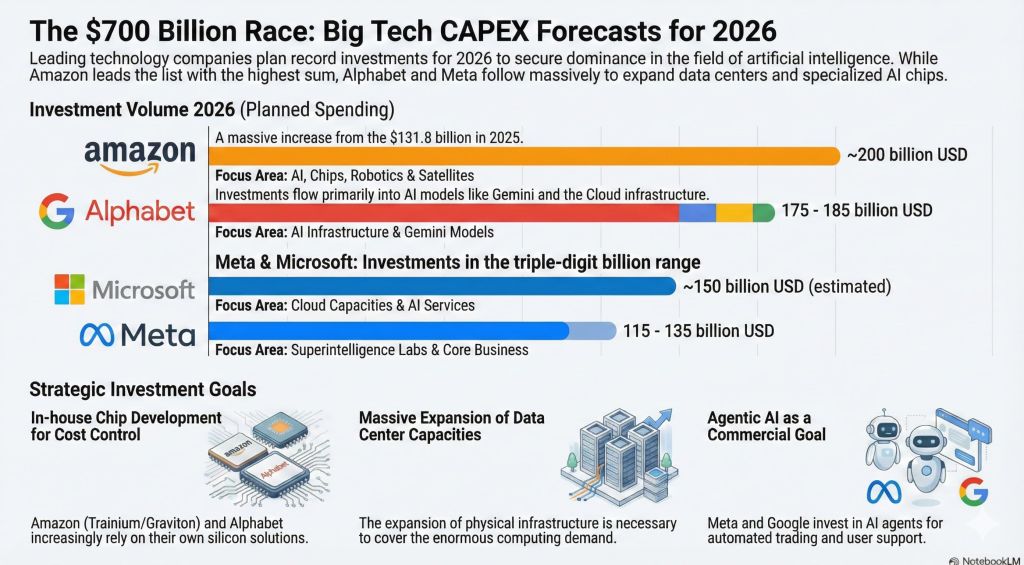
Amazon has put itself at the top of this investment race and plans to spend around 200 billion US dollars in 2026. This is a massive increase compared to the 131.8 billion US dollars from the previous year. CEO Andy Jassy justifies this massive capital expenditure with the strong demand for existing offerings as well as the great opportunities in areas such as generative AI, proprietary chip development, robotics, and satellite networks.
A key difference compared to competitors lies in the breadth of Amazon's investments. While a large portion of the spending flows into the cloud division AWS and its AI infrastructure – AWS grew by 24 percent in the fourth quarter of 2025 – the company also has to spend significant funds on its physical logistics network. This includes investments in robotics and the modernization of locations. This means that the spending should not be understood solely as a pure AI bet, but also supports the traditional retail business.
Alphabet and the Expansion of Google Cloud
Close on Amazon's heels follows Alphabet, Google's parent company. To meet the growing demand for AI products and underpin its own ambitions, the company plans investments in a range of 175 to 185 billion US dollars for the year 2026. This is a huge leap compared to the previous year, where capital expenditures were 91.4 billion US dollars.
These investments are already showing initial financial successes: The Google Cloud division recorded a revenue growth of 48 percent in the fourth quarter of 2025 and reached an annual revenue rate of over 70 billion US dollars. CEO Sundar Pichai's strategy aims to massively expand the infrastructure for its own AI models like Gemini, which now process over 10 billion tokens per minute. Nevertheless, the sheer sum of spending remains a factor that can weigh on profit margins and free cash flow in the short term.
Meta's Focus on AI Agents and Microsoft's Role
Meta is also intensively participating in this infrastructure build-up, albeit with somewhat lower absolute numbers than Amazon or Google. For the year 2026, the group forecasts spending according to a report by Reuters between 115 and 135 billion US dollars, which represents a significant increase compared to the 72 billion US dollars from 2025. Mark Zuckerberg is focusing heavily on the development of new AI models and so-called "Agentic Commerce Tools", i.e., AI agents that can independently make purchasing decisions and transactions for users. Meta hopes to gain a competitive advantage over other AI providers by using personal user data.
Microsoft, although without an official forecast for the full year 2026 in the available data, operates at a similar level. Based on the latest quarterly figures, annual spending of around 150 billion US dollars can be projected, which would put the company in third place behind Amazon and Google in a direct comparison. In contrast, Oracle with planned 50 billion US dollars seems comparatively modest.
Market Reactions and Risk Assessment
The reaction of the financial markets to these announcements is overwhelmingly skeptical. Investors were concerned about the level of commitments. This led to the share prices of the affected companies giving way, with companies with higher spending tending to be punished more severely. Investors are concerned about the profitability of these investments because even established cloud giants like Microsoft and Amazon are now spending triple-digit billion amounts, the immediate return of which is not guaranteed.
Despite Wall Street's skepticism, tech CEOs are sticking to their strategy. The prevailing logic in Silicon Valley is that computing power will be a scarce resource in the future and only those companies that invest aggressively in data centers and chips now can remain competitive in the long term. However, there is a tension between the long-term technological necessity and the pressure from the markets to justify or at least rhetorically downplay the spending.
Your maintenance expert in data centers
With decades of experience, we know what matters when maintaining your data center hardware. Benefit not only from our experience but also from our excellent prices. Get a non-binding offer and compare for yourself.
More Articles

EU sticks to timetable for the AI Act
The European Union is steadfastly adhering to its timeline for the introduction of the AI
Microsoft plans to relocate new data centers at Ireland’s expense
Microsoft has indicated that the company might reduce its data center investments in Ireland and instead favor the Nordic

Google Environmental Report: Emission trends paint a mixed picture
Google has released its annual environmental report for the year 2025. The tenth "Environmental Report" focuses on the key